

Face-to-face interviews
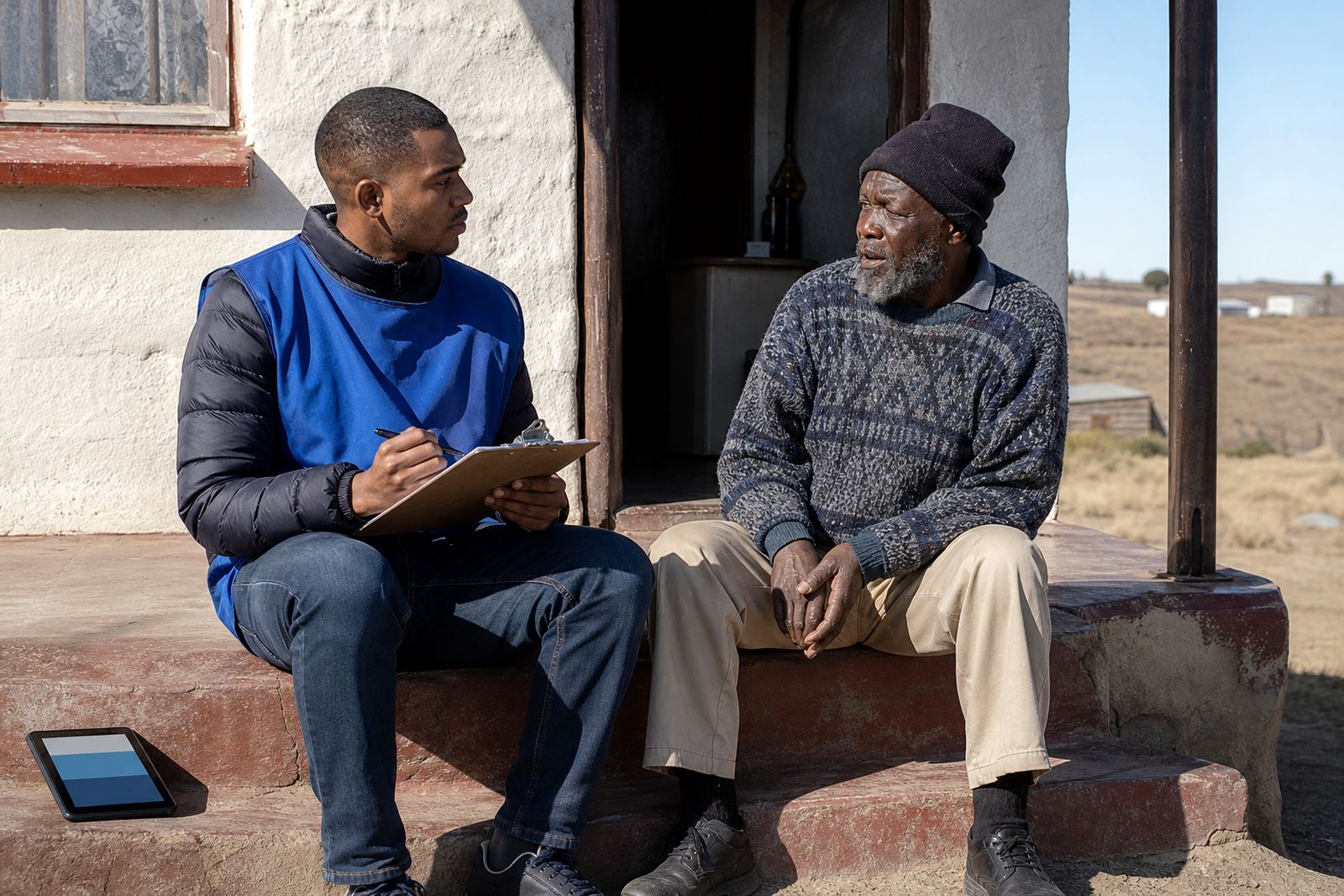
Face-to-face interviewing helps you reach people who are often missed by online or phone-only studies. We run in-person fieldwork across South Africa, with careful supervision, fair questions and clear method notes.
What is included in our face-to-face fieldwork
Our face-to-face interview service covers the practical work needed to speak to people where they live, work, shop or travel. This can include national or provincial polling, consumer research, community issue tracking, service feedback and stakeholder studies. We work from Braamfontein and deploy field teams nationally across all nine provinces, using local language capability wherever the brief requires it.
Each project is scoped to the audience, geography and interviewing conditions. In dense urban areas we may work by suburb, ward or transport node. In smaller towns and rural areas we plan routes around travel time, access conditions and local safety considerations. Where municipal access rules, mall permissions or site permissions apply, we note these early so there are no surprises later.
- Questionnaire review and field-ready scripting
- Interviewer briefing in the required official languages
- Sample implementation and area allocation
- On-site supervision and quality control checks
- Daily progress updates during active fieldwork
- Data cleaning, coding where needed, and method notes for reporting
Where face-to-face interviews work best
In-person interviewing is useful when your target group is not reliably reachable online, when mobile coverage is patchy, or when the topic needs a trained interviewer to guide the conversation properly. It is also useful where literacy levels, device access or language preferences make self-completion difficult. In many parts of South Africa, especially outside major metros, face-to-face work still gives the best route to balanced coverage.
We can conduct interviews at households, workplaces, public intercept points, community venues and other approved locations. The right setting depends on the target respondent and the type of questions being asked. For example, intercept work can suit fast consumer feedback, while household interviewing is often more suitable for broad public opinion work. We will advise on the trade-offs before fieldwork starts and keep the approach practical.
Our process step by step
We start by confirming the research objective, who must be interviewed, which provinces or local areas are in scope, and which languages are needed. From there we prepare the questionnaire for field use, check wording for neutrality, and set the sample plan. If the brief needs quotas or area balancing, these are built in before any interviewer goes out.
Next, the field plan is issued. Interviewers are briefed, routes are assigned and supervisors check readiness. During fieldwork we monitor progress, spot patterns that need attention and verify completed interviews through back-checks or other control steps. If weather, community activity, transport disruption or load-shedding affects timing, we adjust and keep the client informed.
- Project briefing and feasibility check
- Questionnaire preparation and translation planning
- Sampling, quotas and location allocation
- Interviewer training and supervisor sign-off
- Live fieldwork with quality checks
- Cleaning, weighting where required, and delivery with method notes
After fieldwork closes, we prepare the final dataset and reporting tables as agreed. We explain any field realities that may affect interpretation, such as access limits at a venue or uneven footfall at certain times of day. That context matters, and we include it clearly.
What the client should prepare
A good face-to-face project runs better when the brief is settled before teams are in the field. Clients should decide what decision the research must support, which audience matters most, and how the findings will be used internally. If there are must-have segments, regions or question topics, it helps to set these out from the start rather than add them halfway through.
We also ask clients to flag any sensitivities early. This includes restricted sites, regulated sectors, unionised workplaces, member lists, security rules or community liaison needs. For venue-based work, written permission may be needed before interviewing begins. Some sites only allow certain interviewing hours, and some do not permit clipboards, branded clothing or stopping people near entrances so it is best to know this early.
- A clear research objective and target respondent definition
- Preferred provinces, towns or local catchment areas
- Any required language coverage
- Approval contact for questionnaire sign-off
- Site access permissions where relevant
- Reporting needs, timelines and intended outputs
How pricing is worked out
Pricing for face-to-face interviewing depends mainly on the field conditions and the effort needed to complete quality interviews properly. Travel distance, interviewer time on the ground, language coverage, supervision levels, site permissions and the complexity of the questionnaire all affect cost. A short intercept study in one metro is priced differently from a multi-province household project with dispersed locations.
We also consider timing. Projects that need evening or weekend work, remote area travel or repeated call-backs usually require more field time. In coastal areas, humidity and rain can affect paper handling and foot traffic, while in some inland areas long driving legs between points can reduce daily completion rates. These are ordinary field realities not problems, but they do shape the budget.
Where weighting, open-ended coding or more detailed reporting is needed after fieldwork, that is scoped in advance. We explain the cost drivers in plain terms so the client can choose a practical approach.
Aftercare, reporting and method notes
Once interviewing is complete, we do not simply send over a file and disappear. We package the results in a way that helps the client use them responsibly. That includes clear method notes, field dates, area coverage, interview mode, language handling and any material limits that should be kept in mind when reading the findings.
If the study forms part of a wider tracking programme, we can help align future waves so wording and field procedures stay comparable. If internal teams need help understanding what a face-to-face result can and cannot show, we talk them through it plainly. We are non-partisan and confidential in our handling of client work. We do not campaign, canvass or publish client data, and we keep the focus on accurate research practice.
For follow-up work, we can advise whether the next step should remain face-to-face or shift to phone, online panel or a mixed-mode approach. Sometimes the right answer is to keep the field model exactly the same, sometimes it isnt.
What our Opinion Polling customers say
Verified Google reviews
Questions we get asked
Can you run face-to-face interviews outside Gauteng?
Yes. We plan and manage in-person fieldwork across all nine provinces, including metro, township, small town and rural locations, subject to access and safety conditions.
Do you provide interviewers in different languages?
Yes. We arrange interviewer coverage in the official languages needed for the study and plan deployment around the language mix of each area.
Will you share our survey data publicly?
No. Client data remains confidential. We do not publish client data, and we do not use fieldwork for campaigning, canvassing or election prediction.
Also worth a look



Tell us about the job
Send sizes, materials and where you are through our contact form, and we will come back with the practical options.
Open the contact form