

Sampling and weighting
Good polling starts long before the first interview. Sampling and weighting are the parts of the job that help a survey reflect South Africa as it is, not just the people who were easiest to reach.
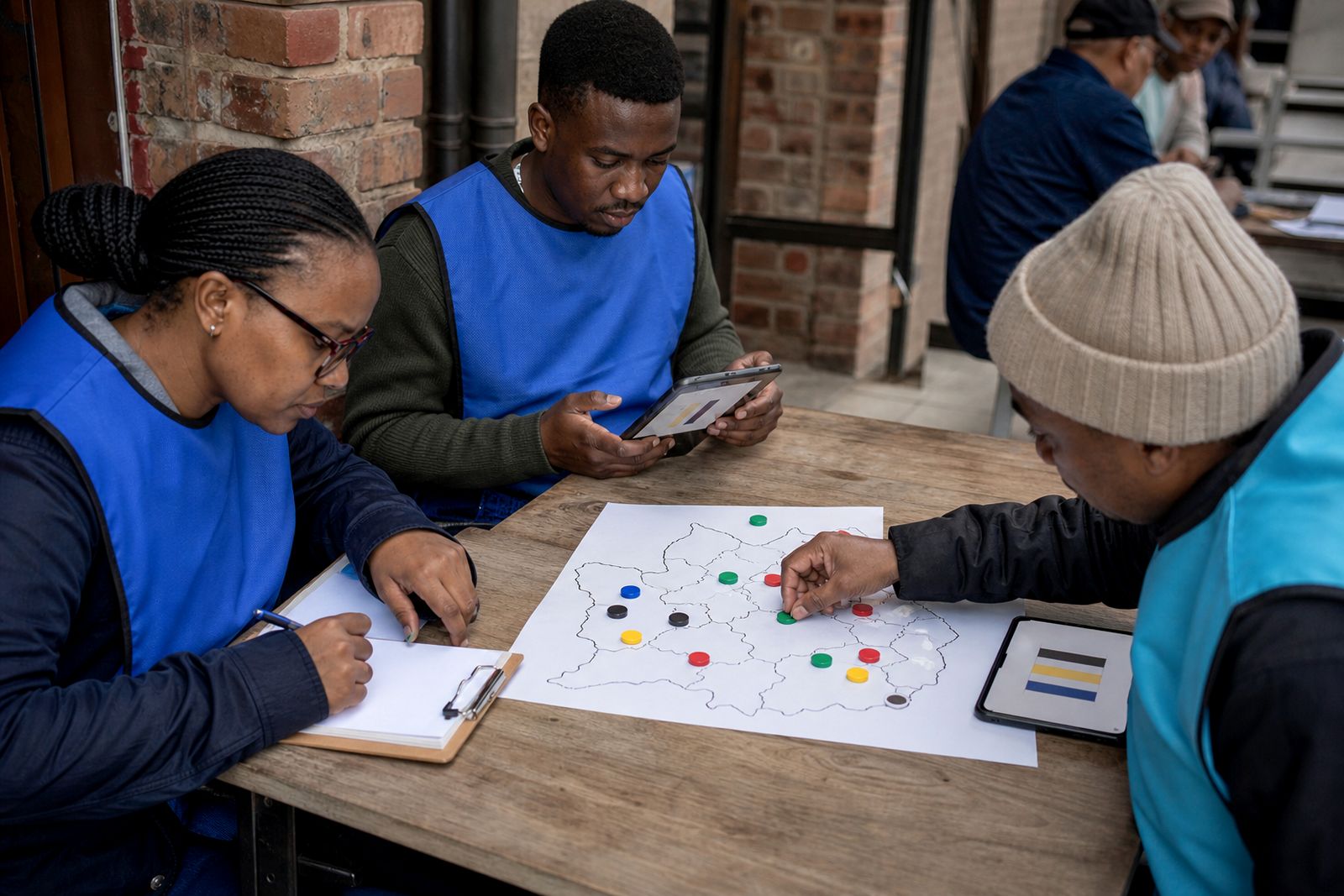
Why sampling matters before weighting
Sampling is the process of deciding who gets a chance to take part in a poll or survey. If that starting point is weak, weighting can only fix so much. A well-run sample begins with the research question, the population you want to understand, and the field method that suits the task, whether that is phone interviewing, online panel work, or face-to-face interviewing in communities across the country.
In South Africa, practical conditions shape sampling from the start. Mobile access differs by area, online reach is uneven, language preferences matter, and travel times can change sharply between a dense urban ward in Johannesburg and a rural area in Limpopo or the Eastern Cape. During load-shedding, calling windows and online response patterns also shift, so timing must be planned and watched carefully.
Before any weighting is applied we ask a simple question: did the sample give the right people a fair chance to be included? If the answer is no, the best next step is usually to improve the field plan, not to lean harder on the maths.
Define the target population properly
Every sample starts with a clear definition of who is in scope. That sounds obvious but it is one of the most common places where projects go wrong. A national public opinion poll may include adults across all nine provinces. A consumer survey may need recent buyers in a specific category. An employee survey may cover only current staff, not contractors or former members. These choices affect screening, quotas, fieldwork routes and how results are later weighted.
We also define what the survey is not trying to represent. If a study only interviews people with recent service experience, it should not be described as a view of the whole public. Clear scope protects accuracy and helps decision makers read the findings fairly.
- State exactly who is eligible to take part.
- Set the geography clearly, national, provincial or local.
- Decide the mode before fieldwork starts.
- Confirm language coverage and translation needs.
- Write screening questions that are simple and neutral.
That early discipline saves trouble later, and it makes the method notes much easier to read.
Choose a sample plan that suits South Africa
No single sample plan fits every project. For a national poll, we may spread interviews across provinces and settlement types so that major regional differences are not missed. For face-to-face work, interview points must be selected carefully and monitored closely. For phone studies, call schedules should cover different times of day and different days of the week. For online work, the panel mix needs to be checked against the audience being studied.
South African fieldwork also needs practical judgement. Coastal humidity can affect paper materials and device handling in some areas, while summer storms or service delivery disruptions can slow movement between interview locations. In gated estates, student residences, hostels, farms and informal settlements, access rules are not the same. A sound sample plan accounts for these real conditions rather than pretending every respondent is equally easy to reach.
- Match the field method to the audience.
- Spread interviewing over provinces and community types where relevant.
- Use all official languages needed for fair coverage.
- Monitor hard-to-reach groups during fieldwork, not after it.
- Keep a record of substitutions, callbacks and non-response patterns.
The goal is not a perfect sample on paper. The goal is a workable sample that stands up in real field conditions.
What weighting does and what it cannot do
Weighting adjusts the achieved sample so that it better matches the target population on selected characteristics. In plain terms, some completed interviews count a bit more and some count a bit less. This is useful when certain groups respond more readily than others, which is common in polling and survey research.
But weighting is not a miracle fix. It cannot create opinions from groups who were barely reached, and it cannot repair a biased questionnaire or poor interviewer practice. If younger respondents were underrepresented because calls were made at the wrong times, or if a province was thinly covered because field routes were cut short, that weakness still matters after weighting.
Good weighting starts with sensible targets and a limited set of variables linked to representation, such as province, age band, gender, language group or other relevant markers defined in advance. Overweighting too many cells can make the data unstable, and that is one reason method notes matter. Readers should know what was adjusted and why.
Weighting should make the sample more believable, not more complicated than it needs to be.
A practical weighting checklist
Once fieldwork is complete, weighting should follow a controlled routine. We compare the achieved sample with the target profile, identify where the imbalances are, and apply adjustments carefully. Then we check whether the weighted dataset still makes sense in plain language, not just in a table.
- Confirm the final eligible sample before weighting begins.
- Review missing data on key profile variables.
- Set target distributions from a defensible source.
- Apply weights in stages where needed, rather than forcing everything at once.
- Check for very large weights that may distort the data.
- Compare weighted and unweighted patterns to spot odd movements.
- Record every decision in the method notes.
A useful discipline is to ask whether the weighted results still fit what we know about turnout to surveys, access conditions and interview mode. If an adjustment changes the story too sharply, it deserves another look. Sometimes the issue is not the weight itself but a fieldwork gap that should have been handled earlier.
This step is technical but it should not be mysterious. A good method note explains the process clearly enough that a policy team, agency planner or communications lead can follow it.
Common mistakes and the checks that prevent them
Most sampling and weighting problems are not dramatic. They are small preventable issues that stack up. A translation may read differently across languages. An online questionnaire may work badly on low-data mobile use. An interviewer may avoid a difficult route late in the day. A phone sample may lean too heavily on people who answer quickly. None of these errors is unusual, but each one can nudge the sample away from the country you meant to describe.
That is why checks need to run through the whole project not only at the end. During fieldwork we watch coverage, response patterns and interview quality. After fieldwork we test whether the weighting has corrected normal imbalances without hiding deeper flaws.
- Check quotas and coverage daily during live fieldwork.
- Listen for wording problems across languages and regions.
- Watch completion patterns during load-shedding windows.
- Review interviewer notes from difficult access areas.
- Keep reporting transparent about mode, sampling and weighting choices.
The final test is simple: could an informed reader understand who was interviewed, how they were selected, and how the data was adjusted? If yes, the survey is on much firmer ground. If not, the method needs more work, even if the charts look neat.
What our Opinion Polling customers say
Verified Google reviews
Questions we get asked
Is weighting always necessary in a survey?
Not always, but it is often useful. If the achieved sample differs from the target population on important profile variables, weighting can help correct ordinary imbalances. It should be used carefully and explained clearly in the method notes.
Can weighting fix a poor sample?
No. Weighting can improve balance, but it cannot fully repair weak coverage, biased recruitment, unfair questions or thin fieldwork in key groups. The sample plan and field execution still do most of the work.
Why do method notes matter so much?
Method notes show how respondents were selected, what field mode was used, which variables were weighted and what limits apply to the findings. Without that context, readers can easily overread a poll or compare unlike studies.
Also worth a look




Tell us about the job
Send sizes, materials and where you are through our contact form, and we will come back with the practical options.
Open the contact form